
ABOUT

Consortium for Fiber-to-Fiber
Resource Circulation
Background and Challenges
The Reality Facing the Textile Industry
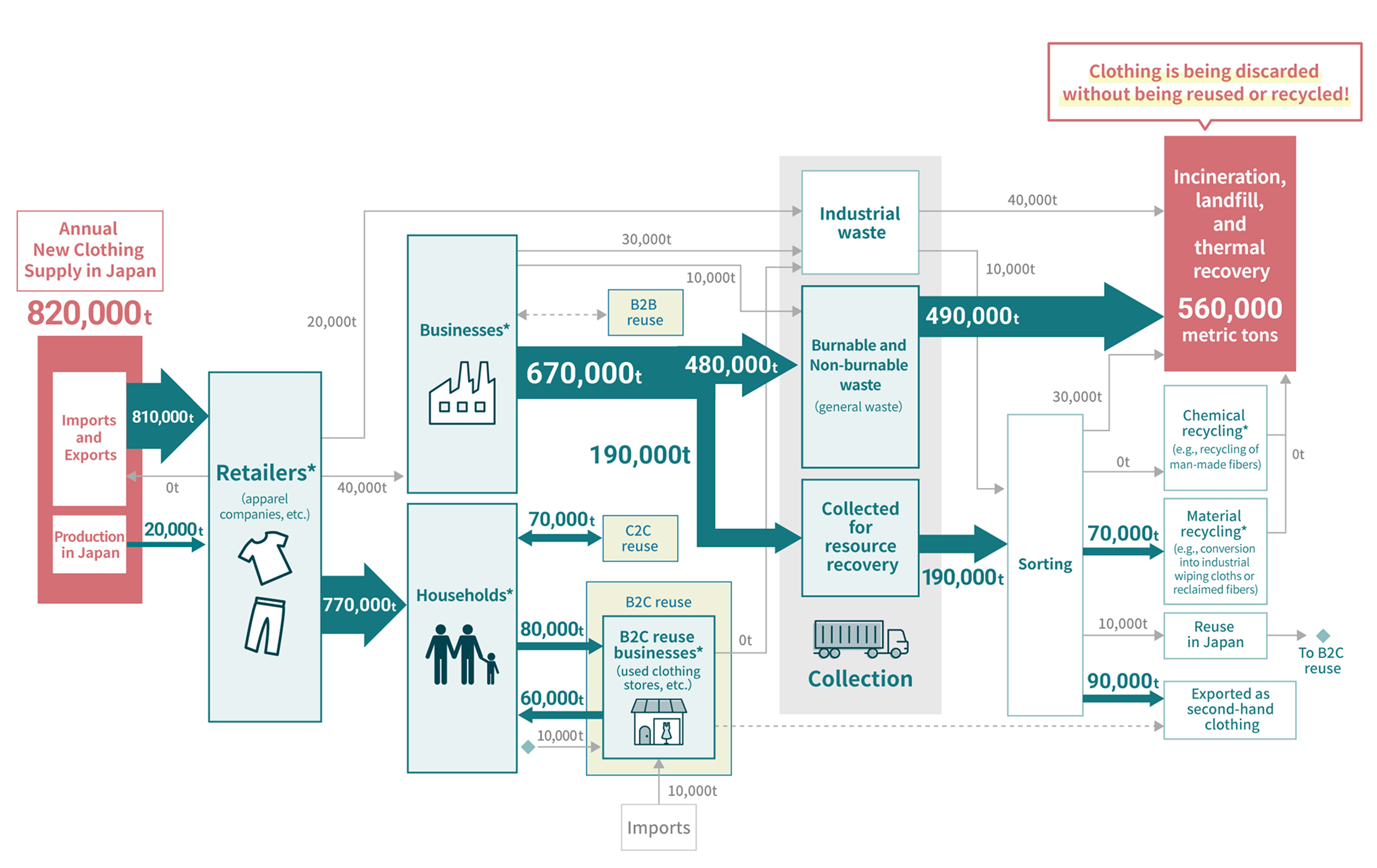
Large quantities of clothing are being incinerated or landfilled.
Clothing is an essential part of our everyday lives. However, much of the clothing no longer wanted by households and businesses is being disposed of without being recovered as a resource. In light of this situation, the textile industry is being urged to transition toward a “circular economy” through initiatives such as fiber-to-fiber recycling.
- Notes:
- • Clothing entering the entities marked with an asterisk has been stored for a certain period of time in inventory, is still in use, or is put into long-term storage before leaving those entities. Therefore, the input and output values for a given estimate year may not match, and any discrepancy represents the annual increase/decrease in stock.
- • “C2C reuse” refers to passing on clothing to family and friends as well as sales through bazaars, offline flea markets, flea market apps, and online auctions.
- • “Recovered as a resource” refers to items disposed of as recyclable municipal waste or collected through trade-ins, in-store collection, or community collection.
- • Dashed lines indicate flows with unknown values.
- • Totals may not add up due to rounding.
- Source: “Material Flow of Clothing, 2024 Edition” (Mitsubishi UFJ Research & Consulting Co., Ltd., July 2025), 2024 Study on Measures to Promote Circular Fashion, Ministry of the Environment of Japan
The Challenges in Textile Recycling
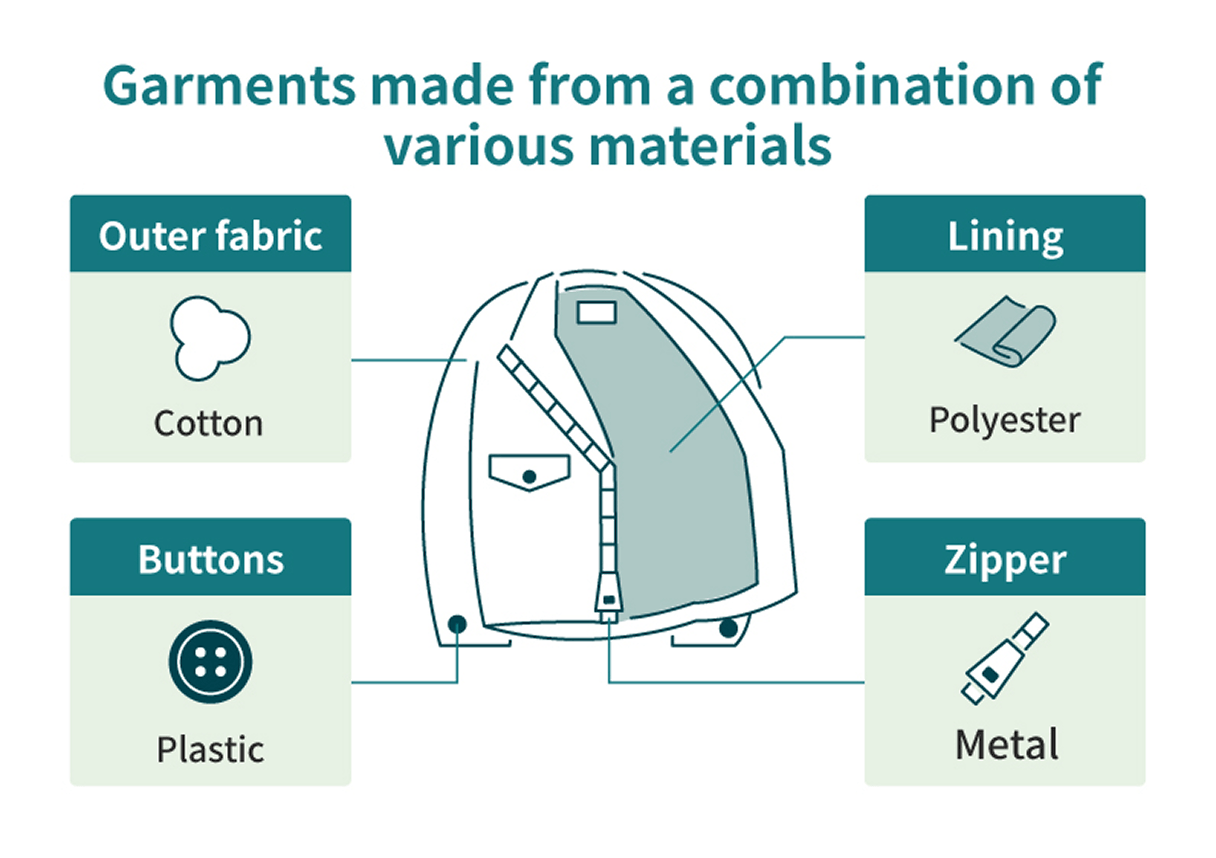
To date, textile manufacturers have been developing recycling technologies tailored to each specific material, leveraging their respective strengths and areas of expertise. However, garments are complex combinations of multiple materials, including polyester, cotton, and wool as well as components such as buttons and zippers — making them difficult to recycle as they are. To recycle clothing, materials and components must first be properly separated. Given the wide variety of materials and components involved, there are limits to what a single company can achieve using only its own technologies and expertise.
Establishment of CFT²
Taking on Societal Challenges Together
To address these challenges and establish a “fiber-to-fiber” resource circulation system, five Japanese textile companies and one biotechnology research organization joined forces: TA FRONTIER CO., LTD.; Kurabo Industries Ltd.; Toray Industries, Ltd.; Nisshinbo Textile Inc.; The Japan Wool Textile Co., Ltd.; and the Research Institute of Innovative Technology for the Earth (RITE).
The six organizations jointly submitted a proposal titled “Research, Development and Demonstration toward the Establishment of a Fiber-to-Fiber Resource Circulation System” in response to a call for proposals under the Biomanufacturing Revolution Promotion Project* administered by the New Energy and Industrial Technology Development Organization (NEDO).
*A national project established under a research and development plan formulated by Japan’s Ministry of Economy, Trade and Industry. The objective of the project is to pursue a decarbonized and circular society by replacing traditional manufacturing processes dependent on fossil resources with biotechnology incorporating microorganisms and enzymes.
The Future Envisioned by CFT²
Transforming discarded clothing into
future resources—and new textile products
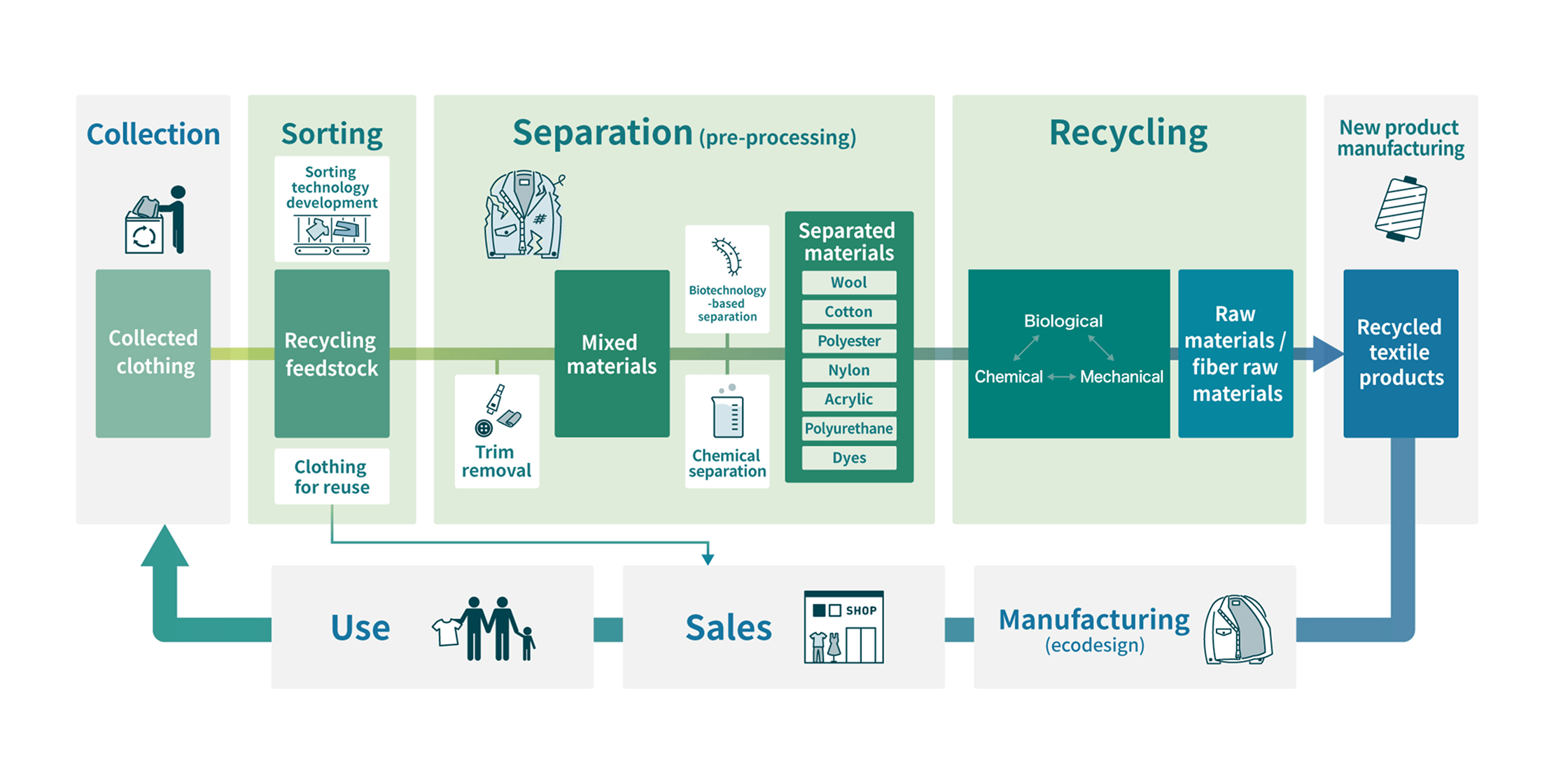
By bringing together the technologies and expertise of the six participating organizations, the consortium is focused on developing technologies for sorting, separating, and recycling clothing. It is also undertaking initiatives to encourage consumers to choose not to discard clothing, with the aim of establishing a “fiber-to-fiber” resource circulation system.
Participating Organizations